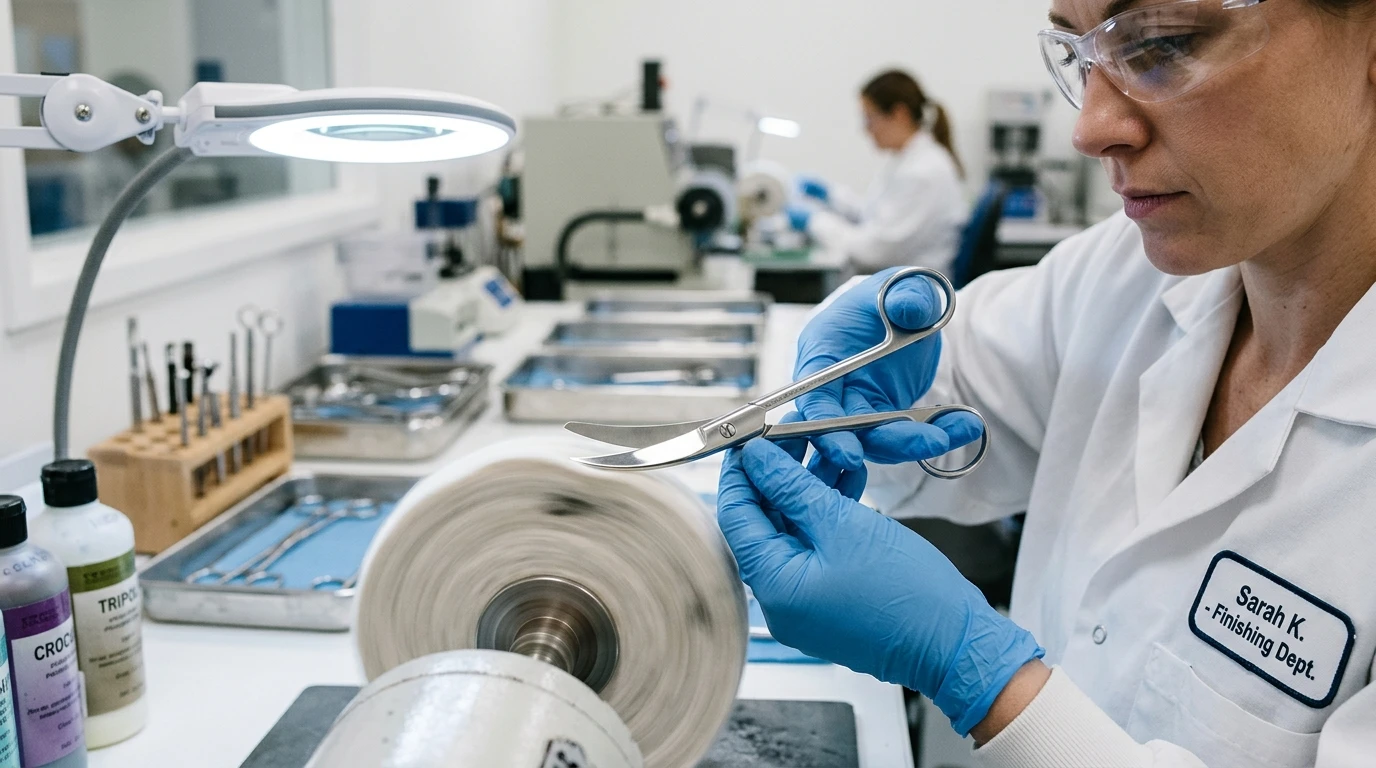
Detailed overview of the metallurgy, tooling, precision grinding, hand craftsmanship, and multi-stage verification methods employed in our Sialkot facility.
Producing surgical instruments demands an intimate fusion of metallurgical discipline, dimensional consistency, and time-honored metalworking artistry.
Every project commences with a technical consultation. We review customer technical drawings, dimension tolerances, CAD models, or physical samples. Intended applications, curvature angles, tooth serrations, and ratchet mechanisms are mapped prior to production setup.
Material selection is dictated by the mechanical stresses of the instrument. Martensitic stainless steels (such as AISI 420) are utilized for scissors and cutting edges to sustain high Rockwell hardness, while AISI 410 or austenitic AISI 304 are selected for forceps, retractors, and trays.
Stainless steel bars are heated and drop-forged into primary instrument blanks. Forging aligns the internal crystalline grain structure of the steel along the contour of the tool, preventing micro-fractures under lateral torque and repeated flexation.
Blanks undergo precision milling to form box lock joints, serrated jaw grooves, ratchet teeth, and hinge mortises. Blade bevels are rough-ground to geometry, followed by vacuum heat treatment and quenching to lock in desired hardness (HRC 45–52 depending on tool type).
Master instrument assemblers hand-rivet, peen, and adjust pivot tension so scissor blades shear cleanly across the entire cutting stroke. Multi-stage wheel polishing produces the client’s chosen finish: anti-glare satin luster, clinical matte, or mirror shine.
Each instrument piece is visually examined under magnification for burrs, jaw alignment, and surface smoothness. Instruments undergo passivating bath immersion, fiber laser batch marking, protective silicone tip shielding, and export-grade desiccated packaging.